
Cultural
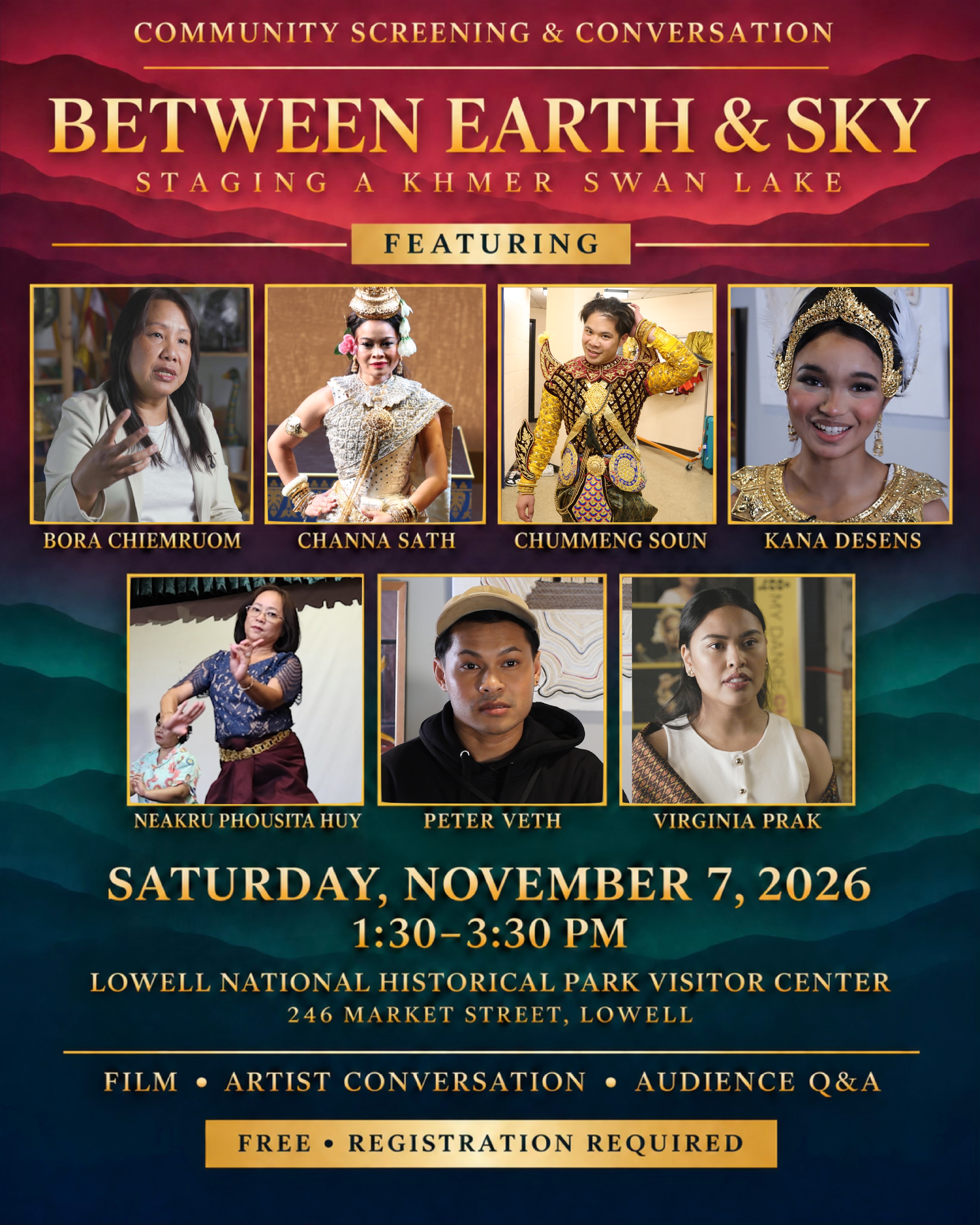
Between Earth & Sky - Staging a Khmer Swan Lake - Angkor Dance Troupe & Director Q&A
Watch the video 1 love
Recorded November 7, 2026, at the Lowell National Historical Park Visitor Center Theater, this audience conversation followed a screening of Between Earth & Sky: Staging a Khmer Swan Lake, a documentary about the Angkor Dance Troupe's nearly two-year journey to retell Swan Lake through Cambodian classical dance. The film's director, the troupe's dancers, executive director Bora Chiemruom, and master teacher Neakru Phousita Huy (speaking in Khmer, with interpretation) talk about choreographing the work alongside master teachers at the Royal University of Fine Arts in Phnom Penh, scoring Tchaikovsky's themes for Cambodian instruments, and the fear of stepping outside tradition that gave way to 20 packed performances at Merrimack Repertory Theatre. Virginia Prak describes dancing Prince Siegfried in 18 of those shows while also serving as a hospitalized mother's sole caretaker, Kana Desens reflects on stepping into a first-ever solo role, and the troupe looks ahead to passing Neakru's knowledge to the next generation and taking the production on tour across the U.S.
Transcript (Approximate)
Between Earth & Sky: Q&A with the Angkor Dance Troupe
Recorded November 7, 2026 - Lowell National Historical Park Visitor Center Theater Transcript v2 - re-transcribed (Whisper large-v3, three independent passes on original and denoised audio, plus targeted re-decoding of difficult passages) and reconciled by hand. Light verbatim: stutters trimmed, spoken wording kept.
[speaking in Khmer] marks Khmer speech, which is not transcribed; the English interpretation that follows is transcribed.
[unclear] marks words that could not be resolved; [?] follows a word or name that is a best guess.
[00:00] I don't know, maybe lets just go to some questions, yeah? If you have any questions for the talents, I know they spent over a year, right? It was like almost two years coming up with the concept, the ideas, and then even going to Cambodia. A few, well, three of you went to Cambodia, and actually two of you went to Cambodia, Chummeng and Peter, who's not here today. They all went to Cambodia and actually choreographed, you know, the pieces with the Royal Fine Arts of, sorry, the Royal University of Fine Arts in Phnom Penh, with master teachers, even composed the music in Cambodia as well. If you hear, like, the soundtrack, the track itself, like the main theme music, it sounds very similar to the original piece, so you might think that, well, that's the original piece, but it's actually put together with Cambodian instruments. And so all the pieces were put together with Cambodian instruments and Cambodian musicians,
[01:04] and the songs itself, if you could hear some of it, was made, was composed, and written in Cambodia itself. And so Neakru Phousita, Virginia, they went to Cambodia and choreographed the pieces, worked with the musicians, worked with the masters, and even the Royal University of Fine Arts dancers to choreograph all the pieces. Then they came back, right, and iterated, you know, enhanced it, improved it, and so on and so forth. Like Chummeng said, right, even to the last day before the performance, they were tweaking it, because they need to adjust it. So, I don't know, maybe you can open up for some questions. I know that a few of us... So the first question I would like to ask: how does it feel to be involved in the production? And I want all of you to answer that, and then we'll take audience questions. But your take on it, how does it feel to be doing the Khmer Swan Lake? Now ADT owns the Khmer Swan Lake. What does that mean to you?
[02:17] [unclear] I guess that would be a tribute to... Gosh, what does it mean to be part of a Khmer Swan Lake, the first ever? And of course, getting the opportunity to go to Cambodia is really special, and I truly miss it. Watching back in the videos, it's like, wow, that was only a couple months ago, but we spent weeks and weeks together just to bring that special production to life. And to be part of it is, I don't know, it's like, it's truly part of me, and it's more emotional, and I can't even explain it because it's so spiritual and emotional that I don't know how to explain it. It's just bigger than I am, and bigger than what we thought it was going to be. So that's my take on being part of a Khmer Swan Lake.
[03:31] For me, I feel very honored to be a part of this project. I never even thought that Angkor was capable of doing this project, or any project just like this. Just think about the classic ballet, you know, there's a lot more stories that I actually want to, I don't know, maybe we can do some more stories, like Snow White or Cinderella, I don't know, something, you know? But it's just so special to me. This project is very, very special. I don't know how to explain it. Just like Virginia, I don't know how that feeling is, but it's just so amazing.
[04:11] I think for me, you know, just turning out as, like, a brand new principal dancer, being in this project, it's very new to me. I'm somebody who loves history, and I love the arts ever since I was little. So really going in with myself and finding out that I'm capable of doing something like this, it wasn't something I discovered alone. It took a lot of critiquing from Neakru, Bong Channa, who believed in me a lot. And in the end, I saw another version of myself I didn't know existed within me before, and that was Odette, a swan, an angel, and many more to come.
[04:56] [speaking in Khmer] Okay. All right, okay. I'll try to translate.
[05:17] This is a very different and unique type of story that we kind of adapted from Swan Lake into Cambodian. [speaking in Khmer]
[05:38] I had a dream of doing something this unique for a very long time, but we didn't have the resources. She really enjoys watching Walt Disney cartoons and kid stories. [speaking in Khmer]
[06:19] And she has always thought that classic and folk, traditional Khmer dances could be transformed into something more modern. [speaking in Khmer]
[07:05] It goes against tradition and practice if we were to take Khmer dance, traditional classical Khmer dance, and do something a bit more modern, because it's not part of the tradition. But using Western and Disney stories, and then using Khmer forms and adapting it to that, making it more modern, they could do. [speaking in Khmer]
[07:53] This is the first time that our troupe has done something that is so out of the traditional form of Khmer dance, because nobody else has done it before, using Khmer classical traditions to do it. [speaking in Khmer]
[08:23] And the master teacher from the Royal University of Fine Arts, RUFA, in Phnom Penh, she was very happy that Angkor Dance Troupe brought this idea to her, because she had never done this before either, and it was a very successful and proud moment for her to actually work on this project together. [speaking in Khmer]
[09:46] I'm going to try to translate what I can remember in my kind of sickness right now. It was very challenging to not only adapt Khmer classical art form, performance art, and Western dance, and make the story not so completely different that people wouldn't recognize it, but the culmination of those two things created a very challenging [situation] for the troupe itself, because there were things that they had to really negotiate and interpret that made it very difficult, because they couldn't stray away from the classical traditions of what Robam Khmer is, what Khmer dance is, and they couldn't really stray away from the original story of Swan Lake itself. And so the two things coming together was a huge challenge. But in the end, with all the sacrifices and the commitment of all the dancers and the performers and the musicians, they were able to put something [together] they were very proud of, and the audience really appreciated. And this is why 20 shows at Merrimack Repertory Theatre in the spring was completely packed. Not every night was sold out, but it was completely packed. And she feels really proud of all the dancers and what they've achieved.
[11:15] [speaking in Khmer]
[11:52] She was very afraid, worried that the musicians and the master teachers from Cambodia would criticize about the music, right? Why did Angkor Dance Troupe use Western music with Khmer instruments, right? So she was very worried about that, but she had answers for that as well. [speaking in Khmer]
[12:28] But in the end, there was no criticism, and everybody, not everybody, but most people complimented the performances, the production itself, so she was very happy about that. [speaking in Khmer]
[13:23] Like earlier, she mentioned it was always a dream of hers to come up with something like this, and just never had the opportunity or the resources to put it together. And thanks to our exec director, Bora Chiemruom, who was able to go out there and find the funding to actually put this production together, and also the partnerships.
[13:43] Can I just add that Neakru didn't want to do it because she was so scared? I'm like, no, I know you can do it, I know you can do it, and they did, yeah. Right? Many times you guys are like, no, we can't do this. I said, no, we're doing it, that's it. But yeah, no, it's been a joy. And watching this over again, I got really emotional. What we accomplished is beyond my expectation. All of you did it. [speaking in Khmer] You can translate that.
[14:21] She said, when I told her that, yeah, we're going to move forward with this, and we're going to get money for it, she's like, oh no, now I'm going to pray, like, don't get the money. Because I'm scared for the dream [?] project, I can't do it. Yeah, but I believe that you could. Remember that? I kept telling all of you, I said, I believe in all of you, and you could do it, and look what you accomplished.
[14:49] So, questions? Questions? Yes, sir.
[14:51] I'm curious about the collaboration with the Boston Ballet. How much of a role did they play, and did they see the production? What did they think of it?
[15:00] There was no role. We went to, we went to see, they went to see the Nutcracker, and then after that we went to see The Swan Lake before we did the show, because we wanted to just get the story, to get the feel for it. But there was no collaboration. I invited the executive director at the time to come, but she couldn't make it. But then after the show, everybody from Boston have reached out to myself: how can we bring it to them? So, and so many other places has also reached out that they want the production, and I'm so happy to share that we now have seed money to start planning for touring across the U.S.
[15:50] In the YouTube, from ballet, classical, I watch every night, and watch for the gesture from Swan Lake, how the ballet dance like that, and how I put in my gesture to put in the Swan Lake.
[16:12] More of an inspiration than a collaboration.
[16:16] And one gesture, I went to D.C., I saw the swan swim on the pool, and then I looked, and I saw the one gesture, who put his, the swan [leg?], do like, do like this. [unclear] I sit like this, and you see that one? Yeah, that one, I from D.C.
[16:46] I think I want to add to that, because I interviewed many of them, and the people on stage today, they're in the documentary. There were other people that didn't make the cut, because we had to put the documentary into, like, 25 minutes. Originally, it was supposed to be 12 minutes or less, but the story spoke for itself. And some of the talents, when I spoke with them, you know, how did this idea come about? And what would I just mention? Well, they went to actually see Swan Lake on stage. And it was more of, like, I guess, capacity development, or like, you know, just because they didn't, this is the first time that they're doing something where they're having to emote, and show emotion and expression on their faces. And being on stage, if you're a crowd, if you're in the audience from a distance, you really can't see, like, what's going on with the expression. So some of them were saying, like, we have to really act this time, whereas Khmer dance, unless you're doing, like, kind of Lakhon, which is more of, like, folktale and lots of kind of clown theater, then you're not really showing all that much expression. So they had to train themselves how to be more expressive in all, like, you know, their mannerisms and their, kind of, their facial expressions and whatnot. And I mean, maybe you guys can speak about that.
[18:19] Thank you. [unclear] And I want to see, you played the perfect prince. I don't ask you to. Thank you. Yeah, you can speak to that. Okay. Virginia did all of the shows. Yes.
[18:33] So I did all, I guess I would say 18 shows out of the 20. And I was solely the Prince Siegfried. And it was Bong Peter that was, like, plan B if I were to get sick or something. And luckily, I did not get sick. And surprisingly, I was actually very, I would say, strong, since doing all of those shows back-to-back, and in that costume, like, we're all sewn in, and I'm in that thing from, like, 3 p.m. to 11 p.m., so it's, like, no bathroom, no nothing, yeah. So it's very tiring on the body. And I know Neakru and everybody else had concerns for me, whether I could basically perform my best every single night. And I took that as a challenge once agreeing to this role. And I was like, you know, I've been dancing for over 25-plus years and teaching, and I thought this was the perfect opportunity where I could actually become a performing artist full-time. And it was so much fun, and I miss it. And I really challenged myself each day, whether it was, like, eating healthy or exercising daily, making sure my body was right to come on stage and, like, not weak.
[20:08] And if you did watch the show, I was on there for a lot of times, and it was very tiring, especially the battle scene. The battle scene always took me out, depending on my partner as well. There was many different Garudas, so I knew, like, whoever was performing, I would have to brace myself for who was dancing with me, such as, like, Chummeng. He's just, like, physically strong and heavy. So, like, if he just does this to me, like, I will fly. So I had to, like, brace myself and know who I was dancing with, and be very cohesive with my partners, especially as, like, my female partner.
[20:53] So, speaking on emotions and stuff, my character, I would say, had to go through so many emotions. From the beginning, I had to be, like, a little kid, almost, like, you know, the prince, becoming of age, getting his father's bow and arrow, and taking honor and pride in that. And then also falling in love is a different emotion, when I see the swans, and then being gentle and light. But then, and then just going through another emotion of falling in love, and then getting very angry and, yeah, betrayed with the black swan, and feeling really just guilty coming back to the scene with the white swan. Being like, I didn't know that was a duplicate of you, you know? Like... So, and then going into the battle scene, and that was, like I said, took me out most days, just really being aggressive and having so much energy, and coming back again, and coming into, like, a heavenly scene.
[22:10] So throughout the show, I went through a cycle of so many emotions, and I guess how I prepared for that was just really being in the story and being in the character. And I really used, like, my own life's experiences to emote everything. Most of the time, like, out of the 18 shows, I cried every show on stage when it was my, like, betrayal scene, or, like, when I saw that the white swan had died. So, and that's also mentally and emotionally exhausting when you're crying every single day. But I would say, like, really just having the support of everybody around me, and, like, my family, my dad's family, is, like, what kept me going and what kept me strong. Because without them, I would not be able to be the artist that I was for Prince Siegfried. Yeah.
[23:18] [speaking in Khmer]
[23:37] Yeah, so just in Cambodian dance in general, you would never perform this many shows back-to-back, or even two shows within one day. So it's never really been done before. [speaking in Khmer]
[23:57] Yeah, she was very worried for Prince Siegfried's role because of the energy that it took. [speaking in Khmer]
[24:11] Yeah, so it's very difficult as the male role in this art form to execute every gesture and just execute the character properly. You can't just find a replacement if somebody was sick or wasn't able to do it. It's very specific in every gesture and movement. [speaking in Khmer]
[24:49] Yeah, so like I said earlier, I had Bong Peter [?], the director, as my replacement. But in Cambodian classical dance, mostly females dance the role, and that is kind of like the rule. And because Neakru comes from the traditional background from Cambodia, she wants the female to dance the male role. [speaking in Khmer]
[25:33] Yeah, so she was very, very worried for me for all of the shows, and agreed to have Peter be the plan B, or have him perform, like, the daytime shows when we had the two shows. So she was okay with that. [speaking in Khmer]
[26:22] Yeah, so she prayed to all the higher beings, every god there was, and was hoping for my health and my wellness to be just good every single day coming in. And she was just very happy that I was okay every day, and she would ask me every day to make sure that I was okay to perform. [speaking in Khmer]
[27:16] Yeah, so, um, during the show... Do you want me to translate? I'll try. My mother was very sick and going to the hospital every single day. And I was her caretaker, her sole caretaker. And this was happening during the event of the show, the whole month, and only the crew and, of course, the family knew. So she was very worried that I wouldn't have the mental energy or the physical energy to perform every day, perform my best every day. And very challenging. But I used my performances every day as my therapy from what I was dealing with outside. So she's saying that, like, this experience for me has made it very special and, like, more powerful, that I used my life experience and poured out my energy and my heart and my love for Khmer dance into this production. [applause]
[29:00] I have a question. Why was Chad [?] in the film? I'm just kidding, I'm just teasing. It's a question from Chiana [?]. I love that you have that piece in there, maybe Sophie [?], the part that you talk about Neakru aging. You guys all look great, by the way. [unclear] So how do you feel about being the next step up, being, you know, the Neakru in a few years? And then will you be able to carry on her vision, like, you know, all the Disney movies? And when is that coming out?
[29:41] Like I said in the film, I love you. It just gets me so emotional, just thinking about her age, you know? And also, it just goes to everyone that are part of the dance troupe. But for her [unclear], I don't know if I'm good enough yet to take her place. But I'm trying. I'm trying very best to learn everything I can from her. I may not be like her, but I know that once I put my heart to it, I know I can do it. I'm so grateful of her, grateful of you. I mean, every knowledge that I've gained from her, I'm very grateful. I just hope that I can deliver and send those messages to our new future. And I hope that I can do what you can do for us.
[31:12] It's not easy talking about what it would be like if we didn't have her, because she is like a mother to us. And we were very, very young when she first nourished us and basically planted her seeds with us. And I would just say, like, the future without her, I know that she would always still guide us, and whether she's not here or not, but I think she's passed down. And I feel very honored to have her pass down her treasures with us, and very few of us. But I think not just, like, dance techniques or everything, just, like, her values. And just passing down her values to us is special, too, because we will treat our students and the next generation as if it was her. So I think, like, her legacy will always live within us.
[32:31] I know that, for us, you know, like, Kristine [?] and I, we've been involved in the [unclear] for the last 30 years, when my wife first came to the U.S. And Virginia and Channa and Peter, like, my kids, they're like seven, eight years old, running around in the backyard, eating at my home, sleeping at my home. I'm like, okay, actually. And for the last 30 years, Angkor Dance Troupe has changed so much, from a local to national to international. Local, remember that, you know, just a small one, and I was the board president, you know, for two terms. And later on, we, Channa, helped Lowell become the first city in America to win that award [?]. Remember that? You know, [unclear] former mayor. Later on, we got invited to the White House, and they [unclear] for an award. And also we got invited, and then we started having the three major performances. The first one is Apsara [?] Dancing Stone, beautiful. And we performed a few times. And the second one was Live Aid [?]. Internationally, they traveled to France, to Paris, to [perform] in Paris, actually. And the third one is the top, you know, Khmer Swan Lake [?]. And all these kids are doing so well. They're growing up so well. My daughter danced with the two [of them] when she was three years old. She's now 27. And my son, you see the monkey? This is my son also. And those kids are doing really, really well, you know. [unclear] They learn to be very disciplined, very committed, and have done a wonderful job in their profession and their future. And I'm very proud of them for the last 30 years. [speaking in Khmer]
[34:49] She's saying she has confidence in us as the next generation to teach on her knowledge, and especially the dance gestures, which is very important to her, and Cambodian classical dance. [speaking in Khmer]
[36:10] So she's saying that because we are born in America, and there's a language barrier, we kind of don't understand the direct meaning of the gestures. She has confidence in us teaching the next generation; however, within understanding fully each gesture and meaning of the gesture, because of the language barrier, and our understanding of the Khmer language is not 100%, that would be challenging if we were to create something. But present day, she is doing her best to share that meaning and that knowledge for every gesture, and especially placement of hand movements and specific everything in Khmer dance, because classical dance is just very specific. And that's what makes us different from our neighboring countries. [speaking in Khmer]
[37:41] So there's a new initiative happening at the moment, where every Sunday, Angkor Dance Troupe has classes for the general members. And then on Tuesdays, what we're doing is, after work, for, like, four hours in the evening, she's training us instructors and junior instructors to really get the knowledge of, like, the in-depth knowledge of, like, the placements and movements, the background of the dances, and just, like, the history of everything. [speaking in Khmer]
[39:04] So she said she's not worried at all. She's ready to go to Florida and retire, actually. And she said she has a lot of just confidence in Bong Channa [?] and I in just carrying this tradition with the next generation. And she really wants us to absorb all of her knowledge and all of her jewels, I would say, just to carry it along with us and share it with everyone else. Thank you.
[39:42] That's one thing you guys don't have to worry, okay? My wife told me I can go to [unclear] in Florida and wait for her there. No, you can't take her.
[40:01] [unclear] My question is for Kana. Normally, you've been only doing repertoire, meaning, like, Chuon Por [?] and all of that, and this is your first time ever debuting as a soloist for Angkor Dance Troupe. What were the emotions that you were going through, and how were you able to portray such an amazing performance, being so new to Angkor Dance Troupe? Because I've been in Angkor Dance Troupe for a long time, and I see something in you, and I'm pretty sure Neakru sees it too. Because for you to be who I am [?], for a big production like that, for someone who's been knowing, what, like, five, six, seven years under Neakru, it speaks volumes to all of us.
[40:52] Well, I love dance. I've been dancing since I was as young as two years old. And I've always been dedicated, like, literally learning from YouTube before I ever joined, like, the troupe and stuff. I've always been dedicated. My grandfather was a musician in Cambodia before he came here, and my mom always talks about how I carry his blood, and my great-grandfather's love for the arts, in my blood. Because when it comes to dance, I take it so seriously. Like, I drop everything just for dance. Even if it means going to practice, missing school, whatever it takes, I'm always going to go to practice or learn something new. And Bong Bora just gave me a head shake and said, don't miss school! But I had a lot of, like, mental challenges with myself. And it wasn't easy for me to quickly adapt to a lead role like that, or a soloist role like that, because I didn't think I would be worthy of something like that.
[42:04] For myself, looking deeper than myself, I didn't realize that other people see what I don't see within myself. So I really had to kind of step into other people's shoes and try to see what other people saw in me that I didn't see. So once I did that, I started mentally preparing myself and saying, okay, you just need to take it one day at a time and understand the story. Look around at the people who support you and who love you, who trust you with this role. You're giving, you're gifted something so special. Take care of it. Don't give up. And that's really what motivates me to keep growing as a dancer, and as an assistant instructor with Bong Channa. It really helps me kind of push my boundaries a little bit with myself as a dancer, and also as somebody who's new to the acting and the film industry world, because ultimately I want to be an actor.
[43:04] And I also want to use, hopefully in the next few years, hopefully I do gain fame, and I want to share with the world what Angkor Dance Troupe is, what my roots came from, and who got me there, who got me to the fame that I hopefully have in the future, or that I already do have in the future. I don't know, the past present is all within us presently. So I guess it was a lot of mental reflection and a talk with myself, standing in the mirror and saying that you are worthy, you are a beautiful dancer, you are meant for every role that you've been trusted with. Don't give up. Always telling myself not to give up is very big. And I have a habit of journaling every single day. It's kind of like saying good morning to myself or good evening to myself. It sets me up for what I choose to happen for the day, not what the day chooses to happen to me. And I really, I make it big with my students. Like, don't push yourself, like, don't pressure yourself, but also don't doubt yourself. Don't doubt yourself. Don't overthink. There's people that love you. There's people that trust you. And if they trust you with something so special, you should also trust yourself with something so special.
[44:28] Any other questions? Oh, you want to add anything?
[44:33] There was one point that Neakru, and I want to go back, in the film, she said there will be hundreds of students that will go through Angkor Dance Troupe. And we estimated there's about 7,000, over 7,000 students that goes through Angkor Dance Troupe. But out of the hundreds, you will only have two or three. Now, I just wanted to say to Virginia and Channa, those are the two or three that stayed. Their dedication, their commitment to this organization is to be commended, because that's really rare, to have them come back and keep coming back. And anything that we do, any project that we do, I always rely on, obviously, of course, Neakru, right? But for the younger generation, I always rely on the two of you. And then when I look at the two of you, I know we can do so much more, and we have so much more to do in the next few years, at least the next three years. So, yeah. So I'm very proud of all of you. And you too. [unclear]
[45:55] So, let's do a shout out to Teresa. Please stand up. Teresa is also our instructor. [unclear] is our youth program coordinator. Cory Boone [?] is also very instrumental in the class: makeup artist, costumer, all of that, and he makes me look good every time. Makes all of us look good. He's like the fairy godmother, actually. Yes, yes. A part of Angkor Dance Troupe, and will continue to be a part of Angkor Dance Troupe. Who am I missing? Am I missing anyone? Oh, wait! We have our board member right here, Carol. And former board member Sheila right there, who was with us over ten years. I want to ask you a question, Sheila. What do you think of where we are and what we're doing, and our young people here?
[46:56] I loved the performance. I loved hearing the inside scoop today. Really very moving. I love the way the troupe is trying new and different things. The collaboration with the Ipswich Orchestra was amazing. And I just keep thinking, I can't see anything better than this. And I keep seeing things that are even better, more amazing, more beautiful, more moving, and it's still staying true to what the troupe is all about: the preservation, but also reaching out to Cambodian dance.
[47:35] Oh, we still have stuff coming up. And of course, we all want to give our thanks to Pu Rata, the supporter of Neakru here. Without his support for Neakru's passions, and for stealing her for all hours of the day, we wouldn't be where we are today. So thank you. And thank you for letting me eat all your food at your house.
[48:08] I just want to add a comment. I want to say arkun [thank you] Neakru and arkun Bong Bora for bringing this vision together. As a Cambodian American coming to, you know, America, I mean, basically, I wasn't born in [unclear], but I came here when I was a month old. So, like, we all share that dream that we didn't even think is possible, right? And you brought this to life. You have a vision that you didn't even think was possible, Bong Bora. Push it with all that energy. All of you guys collaborate together, and you made it happen. So it's such a great example for anybody else, even for, like, me, myself. Like, I even want to dream about being an actor. If I still have this passion, I can push myself through and do something that you think is impossible. So thank you so much for continuing this effort.
[49:10] So that is so beautiful, a great example for all of us. It's so beautiful, and it makes me feel so proud. Can I add one thing? Sure. A lot of our kids are doing really well. Some of them get their master's, you know, some of them get their bachelor's. My two kids, my daughter is a third-year medical school, and my son is a first-year medical school. And everybody do so well because of the discipline that they learn from the dance room [?]. You should see all these kids when they first came, they have no clue. Now they learn to listen, they learn to respect, they learn, you know, it's just a good habit, and it'll prepare them for a bright future. Thank you, everyone. Thank you, everyone, for coming.